
Peter Schütz
21 Apr - 19 May 2007
PETER SCHÜTZ
"Sentient Beings"
The Goodman Gallery presents a solo exhibition of new work by Peter Schütz entitled Sentient Beings.
This exhibition will open on Saturday 21st April and closes on the 19th May 2007.
The exhibition’s title Sentient Beings, refers to the individual’s power of sensory perception, and extra-sensory perception. These 'beings' possess the awareness of self and of the environments in which they exist. Focusing on a realm in which humans coexist with nature, rather than control it, Schütz’s body of work echoes the Buddhist teaching which says that sentient beings are all beings that have minds and the mind is found in all beings that breathe. Teaching that a sentient being possesses a mind, whereas an automaton does not, it is therefore believed that any animal or living being whose survival strategy and behavior appears to depend on the avoidance of suffering should be assumed to be sentient.
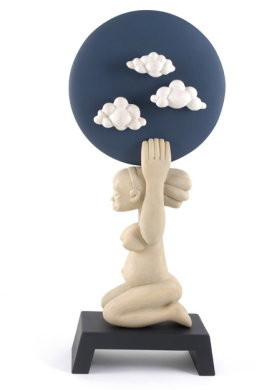
Renowned for his jelutong wood sculptures, Schütz has used the media of sculpture, prints and drawings to explore these ideas. The combination of a traditional carving technique and various forms of construction, that Schütz makes use of to shape his sculptures, results in unpredictable works. This unpredictability also stems from his use of colour on his wooden sculptures, altering the reading of the wood. Working alone, he sees his work as a means of personal expression.
As a basis for this body of work, Schütz has drawn inspiration from a range of influences including the Renaissance, poetry, and early cultures. He broadly deals with the themes of nature, religion and knowledge, that which can be controlled and that which cannot. For this exhibition he has worked specifically with the idea of Christian martyrs, fusing the historic with current events. Using a combination of European and African visual references in order to forge a new mythology, Schütz’s work reflects these contradictions; fusing the sacred and profane, real and imaginary, myths and reality. Working with the figurative, Schütz uses this body of work to express a oneness with the world and nature.
"Sentient Beings"
The Goodman Gallery presents a solo exhibition of new work by Peter Schütz entitled Sentient Beings.
This exhibition will open on Saturday 21st April and closes on the 19th May 2007.
The exhibition’s title Sentient Beings, refers to the individual’s power of sensory perception, and extra-sensory perception. These 'beings' possess the awareness of self and of the environments in which they exist. Focusing on a realm in which humans coexist with nature, rather than control it, Schütz’s body of work echoes the Buddhist teaching which says that sentient beings are all beings that have minds and the mind is found in all beings that breathe. Teaching that a sentient being possesses a mind, whereas an automaton does not, it is therefore believed that any animal or living being whose survival strategy and behavior appears to depend on the avoidance of suffering should be assumed to be sentient.
Renowned for his jelutong wood sculptures, Schütz has used the media of sculpture, prints and drawings to explore these ideas. The combination of a traditional carving technique and various forms of construction, that Schütz makes use of to shape his sculptures, results in unpredictable works. This unpredictability also stems from his use of colour on his wooden sculptures, altering the reading of the wood. Working alone, he sees his work as a means of personal expression.
As a basis for this body of work, Schütz has drawn inspiration from a range of influences including the Renaissance, poetry, and early cultures. He broadly deals with the themes of nature, religion and knowledge, that which can be controlled and that which cannot. For this exhibition he has worked specifically with the idea of Christian martyrs, fusing the historic with current events. Using a combination of European and African visual references in order to forge a new mythology, Schütz’s work reflects these contradictions; fusing the sacred and profane, real and imaginary, myths and reality. Working with the figurative, Schütz uses this body of work to express a oneness with the world and nature.